
CNG/LNG: It’s a Grey Area!
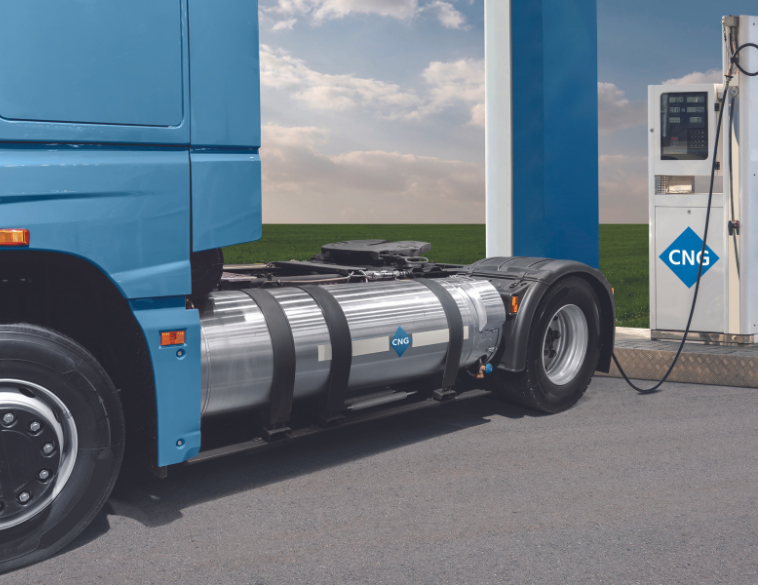
Natural gas is a viable fuel, but it’s not suitable for all applications and all fleets.
[caption id="attachment_382841" align="alignright" width="200"] Charlotte Argue, Sr. Manager of Sustainable Mobility at Geotab. Photo Geotab[/caption]
When it comes to Compressed Natural Gas (CNG) and Liquefied Natural Gas (LNG) as fuel sources for fleet vehicles, Charlotte Argue, Sr. Manager of Sustainable Mobility at Geotab says that the decision to use CNG or LNG isn’t black and white. It’s grey.
“A lot of questions need to be asked and considered,” she explains. “Understanding the type of operation you’re running, what kind of regulatory environment you’re in, what kind of access you have to these fuels, as well as the vehicles that can run on them, are all part of the consideration.”
She stresses that understanding where natural gas makes sense is key. “Fleets need to think about what’s driving them to these alternative fuels,” Argue adds. “And if it’s emissions reductions, I would encourage them to think about ‘well to wheel’ emissions, because in some cases you’re going to get more emissions reductions with one fuel than with another. So it’s important to understand the full impact of your choices.”
No silver bullet
Argue explains that when it comes to alternative fuels, there’s no single solution that’s going to work for all vehicles. “As we look at the next decade, and beyond, we’re going to have mixed powertrains and mixed fuels,” she adds.
Joe Korn, Sustainability Consultant for Holman agrees. “There's no one-size-fits-all strategy for transitioning to alternative fuels,” he says. “The approach to alternative fuels often varies greatly from one fleet to another and might include electric vehicles, or propane, or natural gas, or another fuel.
Natural gas pros and cons
Switching a fleet over to natural gas requires planning and forethought. “If you’re using LNG, you're using cryogenics,” Korn explains. “LNG is stored at approximately negative 245 degrees Fahrenheit, but when you liquefy it, your energy density becomes far greater. So you can store much more fuel in a tank, which gives a Class 8 truck an extended range. And a Class 8 truck is typically where you're going to see this type of fuel being used."
The challenge with LNG, Korn adds, is the potential loss of fuel as the vehicle sits idle. “If the vehicle sits for three or four days, the ambient temperature could bleed off a majority of the fuel. So unless you're burning through the fuel constantly, there's a loss there, and from an emissions standpoint that's a problem, because methane is 10 times more potent than CO2."
[caption id="attachment_382831" align="alignright" width="200"]
 Joe Korn, Sustainability Consultant for Holman. Photo Holman[/caption]
Korn says that LNG can be a good option for long-haul fleets, “as well as certain regional haul applications. For example, some large-scale delivery fleets are starting to get into LNG units, but these fleets often run seven days a week, nearly 24/7, and they’re down only when they’re being serviced."
Most fleets, Korn adds, will opt for CNG over LNG because CNG is easier to work with and doesn’t require complex storage solutions. “It doesn’t change the overall configuration of the truck all that much,” he says.
That said, Korn explains that you cannot retrofit existing diesel-powered vehicles in your fleet to run on natural gas. Rather, he advises fleets to order their vehicles new from the factory to ensure the vehicles have the latest technology and proper engineering. For gasoline-powered vehicles, switching to CNG (or LNG) is an option as long as the vehicle is factory-equipped with a gaseous-prep package. “In layman’s terms,” Korn explains, “this means that the valves inside an engine have to be hardened. That’s because CNG, LNG and propane are dry fuels. There's no lubrication, so the valves have to be able to withstand additional wear and tear."
When it comes to conversion kits for existing vehicles, Korn says he doesn’t recommend them because “most gasoline-powered vehicles are not equipped with gaseous-prep engines, and by not having the proper valves in the engine, it is not a question of ‘if’ a valve will fail but more so a question of ‘when.’ And when a valve fails, repairs can be upwards of $3,000."
The right fuel for application
When speaking with fleet customers, Korn outlines which types of alternative fuels make sense, based on vehicle size and application. “You can break it out into categories,” he says. “So if the vehicle has a GVW below 10,000 lbs., I typically recommend electric or hybrid options. If the vehicle is between Class 3 and Class 6, you have electric, propane and natural gas as viable options, although propane is often the best overall solution. Class 6 through Class 8, you can choose between electric, CNG, and even hydrogen fuel in some applications."
Although natural gas is not a silver bullet, Korn says he does see a long list of benefits, as long as the application makes sense. “It’s cleaner, it can be easier to service than diesel, the fuel is less expensive, and you can save money in the long run,” he concludes.