
Real-Word Challenges of Electric Buses
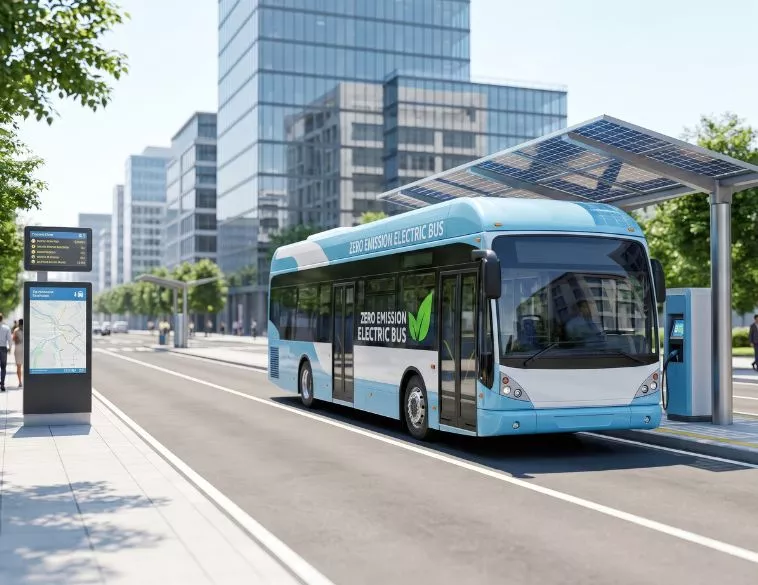

A national study suggests Canada can electrify its transit bus fleet with a 17% increase in vehicles.
Canada’s transition to zero-emission transit could require more buses and electricity than we have today, but the overall impact on the country’s electricity system may be relatively modest, according to a national study published in Scientific Reports.
The study, conducted by researchers at McMaster University, examined the potential impact of fully electrifying Canada’s public transit bus fleet. Using open-source data from transit providers, the researchers modelled fleet requirements, charging infrastructure, electricity demand, costs and greenhouse-gas reductions.
Their analysis estimates that replacing Canada’s conventional transit buses with battery-electric buses (BEBs) would require approximately 14,628 BEBs, compared with about 12,191 conventional buses (including diesel, hybrid, and natural gas) currently in service. That represents a 17% increase in fleet size.
The study also estimates that electrification would require approximately 1.255 terawatt-hours (TWh) of additional electricity annually, equivalent to about 0.20% of Canada’s total electricity generation.
After reviewing the study, Dr. Josipa Petrunić, President and CEO of the Canadian Urban Transit Research & Innovation Consortium (CUTRIC), says national-level modelling needs to be complemented by detailed operational analysis before transit agencies use it to make investment decisions.
“We found this study lacking in several critical areas,” Petrunić says. “The researchers leverage several assumptions that do not always align well with operational reality or actual transit practices. Therefore, the study may miscalculate critical costs and under-estimate the energy expenditures associated with decarbonization.”
“CUTRIC’s studies have shown that in some cold weather conditions, heating and auxiliary loads can consume up to 80% more energy.”
- Dr. Josipa Petrunić, President & CEO, CUTRIC
Moving beyond the depot
One of the most significant assumptions is the study’s reliance on depot-only charging. The researchers acknowledge that their model focuses exclusively on charging buses at depots during non-operational hours. They cite logistical, labour and infrastructure considerations as reasons for excluding on-route opportunity charging. The study also notes that future research could examine on-route charging as a complementary strategy, particularly on high-frequency urban routes.
For Petrunić, however, depot-only charging does not adequately represent the range of operating conditions found across Canadian transit systems. “CUTRIC has completed more than 35 block-by-block studies for transit agencies in Canada and depot-only charging strategies accommodate very few agencies fully, including systems operated by small transit agencies in rural communities,” she says.
Petrunić says the study's use of General Transit Feed Specification (GTFS) data for revenue services does not capture the non-revenue movements that occur before, between and after scheduled passenger service. “Non-revenue services often consume 10 to 15% of a battery's energy capacity,” she adds.
Those movements can include buses travelling to and from depots, deadheading between routes, positioning vehicles for service and other operational requirements. For an individual agency, accounting for those movements can materially change the amount of energy a bus requires, and whether it can complete its assigned work on a single charge.
The bus itself matters
The study assumes the use of 40-foot BEBs, but Petrunić points out that not every transit agency operates 40-foot buses exclusively. Where ridership demand requires larger vehicles, 60-foot buses can be used on specific blocks. “These buses are heavier and consume much more energy compared to 40-foot buses,” she says.
That distinction becomes particularly important when modelling individual routes. A vehicle's size, passenger load, duty cycle and operating environment can all affect energy consumption.
Weather is another variable. The study assumes that auxiliary loads, including heating, can increase energy consumption by up to 30%. Petrunić says CUTRIC's modelling has found that the impact can be considerably higher under some Canadian winter conditions.
“CUTRIC’s studies have shown that in some cold weather conditions, heating and auxiliary loads can consume up to 80% more energy,” she says.
For Canadian transit agencies, where buses must operate reliably through winter conditions, the difference between a national average and the requirements of a specific operating environment can therefore be significant.
“Taken together, these factors can mean a transit agency needs more BEBs – sometimes 30 to 40% more – unless they combine differing charging strategies or mixed green fleet technologies,” Petrunić says.
Charging may need to be a mix
That does not necessarily mean depot charging has no role in an electrification strategy. Rather, Petrunić argues that agencies may need to combine charging approaches according to their operating requirements.
“In many systems, a combination of depot-charging, opportunity (‘on-route’) charging or even hydrogen fuel electric bus ‘mixed fleet’ technologies are needed to achieve full electrification successfully,” she says.
The infrastructure behind the buses
Infrastructure is another area where the national estimates need to be interpreted carefully. The researchers estimate charger requirements using 150-, 300- and 450-kW charging units. Their cost model includes charger costs, vehicle procurement and operating costs. However, the study explicitly excludes certain grid-side infrastructure upgrades because of data limitations.
Petrunić says the omissions extend beyond the electrical grid. “From a cost perspective, this study also excludes facility retrofits, depot structural modifications, substation builds and utility feeder upgrades due to data limitations, but these are material and significant costs that form a core part of the DNA of decarbonization,” she says.
National picture versus local planning
The McMaster study's value lies partly in its national perspective. The researchers describe it as a bottom-up assessment using open-source data to examine fleet requirements, energy demand, infrastructure and emissions across Canada. They estimate that full BEB deployment could reduce transit-related greenhouse-gas emissions by more than 92%, to approximately 130,000 tonnes annually.
For transit professionals, however, the national findings should not substitute for route-level analysis. “Modelling BEB and FCEB [Fuel Cell Electric Bus] deployments is complex and requires precise, operational and empirical data sets,” Petrunić says. “CUTRIC has learned this over more than 10 years of detailed, precise and validated modelling efforts with transit agencies across Canada and in the United States.”
That distinction is particularly important for fleet managers and municipal decision-makers responsible for turning electrification targets into operating plans.
A national estimate can help establish the scale of the opportunity. But whether a particular agency can electrify its fleet with the number of buses, chargers and energy demand predicted by a national model depends on the details of its routes, blocks, vehicle mix, weather, depot configuration, utility connection and operating practices.
These variables can determine how many buses must be purchased, where and how they will be charged, how much electricity will be required, what facility upgrades are necessary, and how much the overall transition will ultimately cost.