
Logging Legends
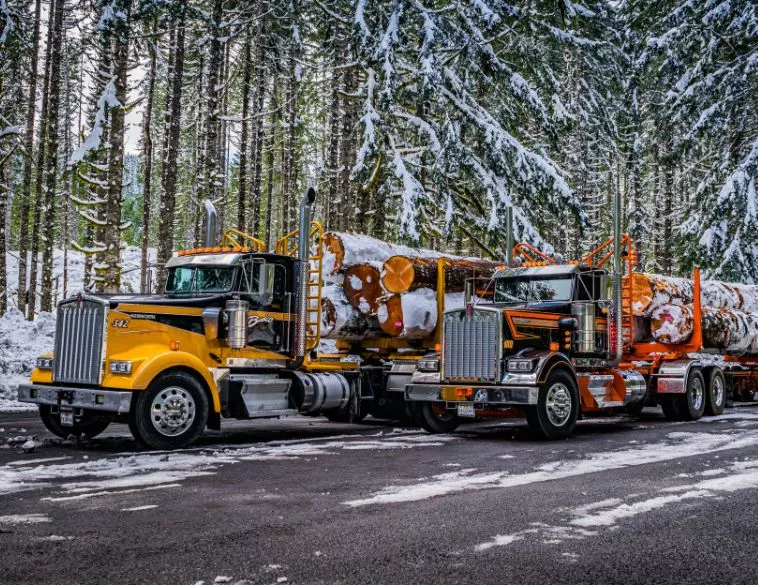
For over a century, Kenworth trucks have been a preferred choice for logging operators. Credit: Kenworth
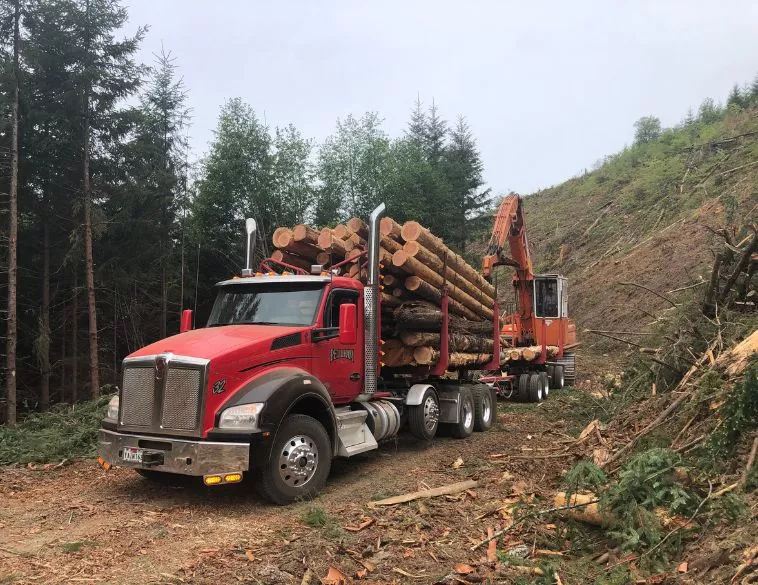
Kenworth’s T880 vocational chassis, is highly popular for logging work. Credit: Kenworth
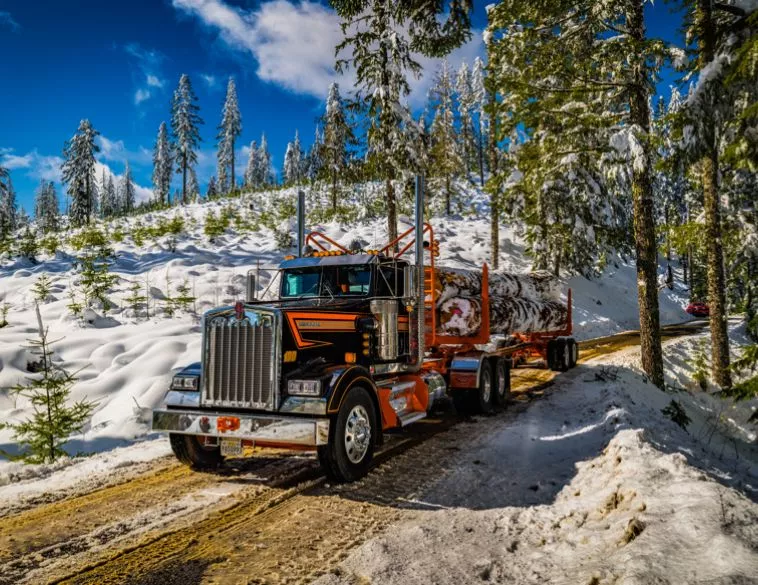
The classic W900B has been a mainstay in the logging industry for decades. Credit: Kenworth
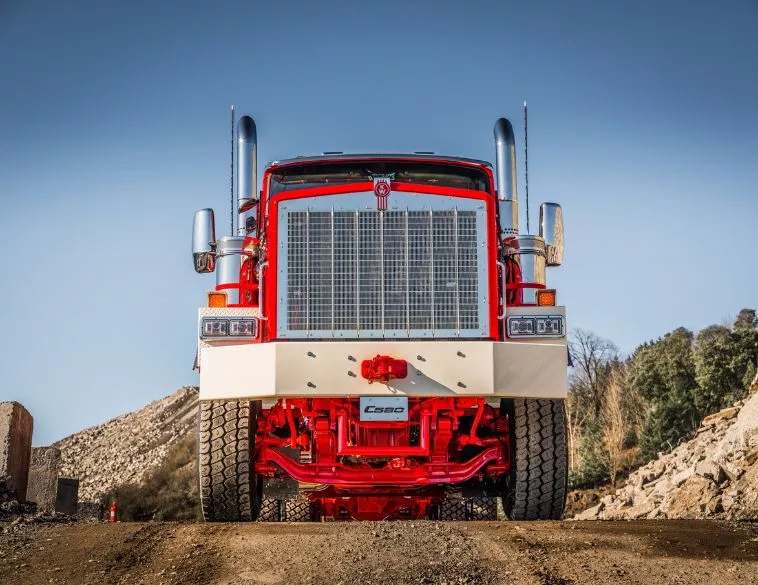
Kenworth’s newest entry in the severe-duty vocational market is the C580. Credit: Kenworth
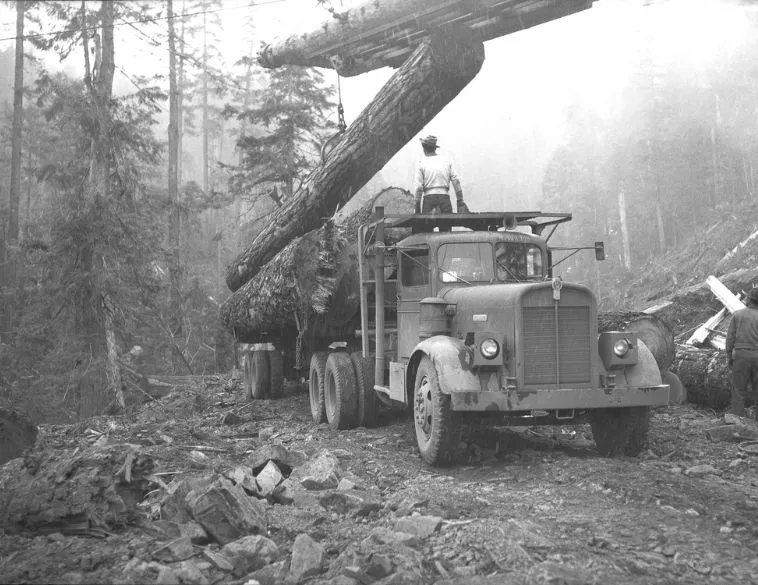
Kenworth’s famous 500 series “Needle Nose,” further cemented the brand’s reputation in the logging industry during the 1940s. Credit: Kenworth

For over a century, Kenworth Trucks have been a mainstay of North America’s logging industry.
Picture the scene. It’s another damp day on Vancouver Island. Mist is starting to lift and as it does, the ancient rainforests echo to the sound of saws, rustling, and splitting bark as giant Douglas Fir trees, Red Cedars and Western Hemlocks are felled.
These massive trees, which form part of the huge Pacific Temperate Rainforest which stretches from Alaska, all the way down to Northern California, represent the backbone of the commercial lumber industry in the region. On the other side of the continent, in the Eastern Temperate Forests, which include large swathes of Ontario and Quebec, similar scenes are taking place. With the trees chopped and sectioned, the logs are prepared for transportation to the lumber mils, where they will turned into structural timbers, plywood and other materials essential in the construction and housing sectors.
“We know that for our customers, downtime matters.”
- Alex Reid, Vocational Marketing Manager, Kenworth Trucks
Extensive ties
When it comes to that transportation, many logging companies rely on Kenworth trucks to haul these loads and for good reason. Founded in January 1923, Kenworth has deep and extensive ties to the logging industry and for decades has offered trucks that are specifically tailored to the unique and severe duty demands that hauling logs frequently require.
According to Alex Reid, Vocational Marketing Manager at Kenworth Trucks, this goes all the way back to when the company was created. “From its headquarters in Seattle, Wash., Kenworth started out as a Northwestern based company that built trucks specifically for Western markets. One of the early applications that Kenworth really excelled at was the logging industry,” says Reid.
“Here in Seattle and the Pacific Northwest, including parts of British Columbia (where Kenworth trucks were marketed and assembled, beginning in 1927), that vocational heritage has been a key part of the company’s DNA for its entire history,” Reid explains.
The current lineup of Kenworth vocational trucks tailored to the logging industry dates back to the T800, first introduced in 1986. This was the second of the brand’s so-called “Anteater’ models [following from the on-highway T600A launched in 1985). These trucks were so named because they had a sloping hood, designed to improve aerodynamics, which was a novel feature in the North American heavy truck market at the time.
Succeeding the T800 is the T880, which continues to be a staple offering and one truck that’s highly popular with heavy-duty logging operators. “With the T800, we learned a lot over the years about what a Kenworth vocational chassis meant for our customers,” states Reid. And, with the T880, Kenworth was able to further enhance that experience and customer needs within vocational markets such as the logging sector. The T880, introduced in 2014, builds upon the T800’s strength in the vocational market, including a robust double frame rail design, available severe duty suspension designed to cope with heavy payloads and rough logging roads, plus a high level of customization to suit operator requirements, including frame lengths, axle configurations and powertrain options. The T880 differed from its predecessor in introducing a new 2.1-metre stamped aluminum cab that added a whole host of additional driver benefits, including improved comfort, ergonomics and insulation. “Since we launched the T880, it has become North America’s favourite vocational truck across a whole range of applications, including logging,” says Reid. Kenworth T880s are in widespread use across Canada and the United States in the logging sector with both owner operators and commercial logging fleets.
True icon
Alongside, the T880, another Kenworth truck that continues to be popular with logging operators is the W900. This truck is a true icon, having been first introduced in 1963. It’s the classic, long nosed traditional style Kenworth conventional featured on TV and movies, including Smokey and the Bandit, and the James Bond adventure Licence to Kill. W900s have been plying the highways from coast to coast for decades and still continue to be used extensively in the logging industry. For loggers, the W900B model (first introduced in 1982) has long been a mainstay. Unlike the latter W900L, it features a standard hood configuration resulting in a shorter Bumper to Back of Cab (BBC) measurement, making it more agile when used on tight, narrow logging roads. It’s combination of a rugged frame, durable, high quality construction and proven proprietary driveline components including engines from Cummins and Caterpillar, and heavy-duty Fuller 18 speed manual or automated transmissions, have made it a popular choice for logging fleets and owner operators. Kenworth is phasing out the iconic W900, having released a limited run of 1000 Legacy Models that pay homage to this truck’s rich history, but even then, W900s will likely be a common sight both on and off the road for decades to come.
Although the classic W900 is being phased out as a new purchase, those logging operators seeking a traditional style Kenworth heavy duty truck for on/off-road also have an option in the W990, an updated conventional that uses the 2.1-metre cab and offers stout PACCAR MX-11 and MX-13 engines designed to maximize power and fuel efficiency while meeting modern emissions standards.
Reid notes that logging operators tend to have “a real sense of pride in the work they do and the equipment they operate.” For them he says, trucks like the W900 and W990 represent the epitome in terms of prestige, with their timeless style, acres of chrome, proud heritage and sheer presence.
Newest addition
For even more severe duty use, including some of the more remote regions of the Pacific Northwest and the northern boreal forests, Kenworth is also introducing the next-generation C580. Slated to begin production in January 2027, the C580 can trace its lineage back to the C5 from 1972. Like its predecessor, the C500, the C580 is engineered to operate in conditions as extreme as arctic mines and northern Alberta oilfields, as well as hauling heavy log payloads along rough roads in all kinds of weather conditions.
The C580 utilizes a version of the 2.1-metre cab, though it incorporates a range of modern technologies, including Kenworth’s “SmartWheel,” and 15-inch digital instrument panel display, as well as electronic mirrors and parking brake. It also features heavy-duty cooling with a high-capacity 1780 sq-in module to provide extra cooling capacity for high horsepower engines or extended low-speed driving or idling under extreme conditions. It can be offered in a whole host of different drive configurations including tri-drive axles and twin steer setups, and sports a wider, redesigned hood with removable side panels for easy access, cowl mounted external oil filters and heated LED headlamps.
While choosing a truck that’s up to the task and meets their specific payload and operating requirements is essential for logging fleets, strong after sales support is essential. “We know that for our customers, downtime matters,” says Reid. “We have an entire team here at Kenworth that is focused on making sure our dealer network is the best there is, and we’re constantly looking for ways to improve.” One example, is Kenworth’s PremierCare Gold certification. This not only takes into account each facility, including the equipment, training and service bays on offer, “but also the amount of dwell time a truck has once it enters the service bay,” Reid explains. “There is no question that our dealers are very, very good at what they do,” says Reid but ultimately, for logging fleets [and any other large truck operators for that matter], having that reassurance that when a truck comes in for maintenance or repair, “that the customer service is the best it can be, and that truck is repaired properly and efficiently, so it can be back out on the job,” is what makes the ultimate difference in the real world.
Kenworth’s Logging Heritage
In the early 1900s, the growth in demand for timber exploded, particularly in the Pacific Northwest region with its abundance of valuable, giant Red Cedars, Cigar Spruce, Douglas Firs and Hemlock trees (recognized as some of the most valuable lumber in the world). In British Columbia alone, the lumber industry was employing 40,000 people by the 1920s, with annual lumber demand reaching almost $90 million. There was a problem however, finding an efficient way to get all these trees from the forest to the lumber mills. Traditional methods had used Oxen which was slow and weather dependent. Later, railway technology gained a foothold, but huge investments were required, beyond what most logging operators could afford. After World War I a surplus of military trucks became available, but in the wet, mountainous Pacific Northwest, most proved highly unsuitable for transporting lumber. Enter Frederick Kent and Edgar Worthington, who acquired the remnants of the Gerlinger Motor Company after it went bankrupt. Gerlinger’s major asset was the Gersix, a robust truck that had caught the attention of logging operators in the Pacific Northwest. Kent and Worthington reorganized the company and continued building Gersix trucks to order by hand. Fredrick’s son Harry Kent, saw an opportunity in building trucks specifically designed for rugged Pacific North West operating conditions, and along with Worthington, actively engaged with logging communities to understand their needs and requirements. On January 22, 1923, Kent and Worthington reorganized the Gersix company, creating the Kenworth Motor Company, which specialized in creating custom built trucks, tailored to individual requirements. Kenworth designed its first purpose-built logging truck in 1928 and since that time, generations of loggers have come to depend on Kenworth trucks to get their timbers from the massive, remote forests, to the lumber mills.