
PACCAR's Canadian Plant: A Winning Trump Card
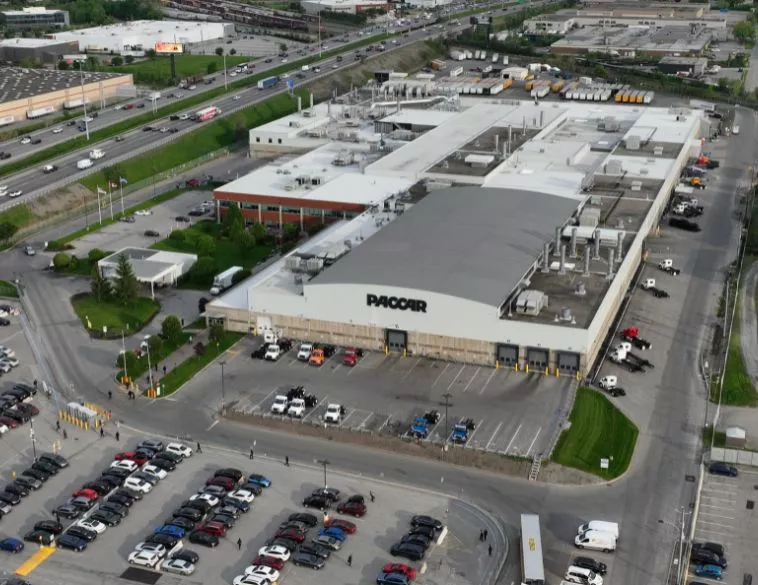

When the Trump administration's trade war reached the Canadian truck market, the 25% tariff could have had a catastrophic impact on PACCAR's Canadian plant.
Already hit twice in 2025 by layoffs tied to declining new truck sales, PACCAR’s Canadian plant in Sainte-Thérèse, Quebec—which until last fall assembled the full medium-duty truck lineup for Peterbilt and Kenworth for the North American market—was facing a potentially dire situation. However, a new production strategy from the group could instead prove to be a significant advantage.
To comply with Trump's push to repatriate vehicle manufacturing, PACCAR is moving production of its medium-duty trucks for the U.S. market to its American plants. In the same move, the manufacturer has announced that nearly all trucks destined for the Canadian market will now be built at its Sainte-Thérèse plant.
For Kenworth, vocational trucks in both tractor and straight truck configurations—the T880 models and the T680 day cab highway tractor—will now be assembled in Quebec for the Canadian market. Peterbilt's 567, 579, and 589 models follow suit, with the exception of the premium Ultraloft integrated sleeper tractor. Not included in the shift are the cabover models: the K and L series for Kenworth, and the 220 and 520 for Peterbilt.
One important point to note: PACCAR has recently expanded its presence in the electric truck market, with one of the most complete lineups available, from both Kenworth and Peterbilt. For Canadian sales, the brand-new generation, which was announced last year as the most innovative on the market, will also be built in Quebec.
A high-performing plant
There is more to PACCAR's decision than tariff politics. The Sainte-Thérèse plant has been part of Quebec's industrial landscape for more than 25 years and is widely regarded as one of the most modern and best-performing facilities in the entire group. It has frequently earned praise from PACCAR's senior leadership for the quality of both its Peterbilt and Kenworth trucks.
The team at the Sainte-Thérèse plant has worked tirelessly to convert and modify its facilities to accommodate a broader range of orders.
Beyond its workforce, the Sainte-Thérèse plant generates significant economic spinoffs for Quebec, particularly in the manufacturing and transportation of truck components.
It is worth noting that Canada is home to only one other medium- and heavy-duty truck manufacturing plant: Hino's facility in St. Thomas, Ontario, where trucks that are also destined for the Canadian market are produced.
Results to come
It is difficult at this point to quantify the full impact of these production changes for PACCAR across North America. On one hand, the vast majority of medium-duty trucks previously built entirely at Sainte-Thérèse were headed to Kenworth and Peterbilt dealerships in the United States. Repatriating that production to our neighbours to the south will therefore have a significant impact on both sides of the ledger.
That said, the specificities of the truck market by vehicle class must also be taken into account. The medium-duty segment (Class 5, 6, and 7 trucks up to 35,000 lbs. gross vehicle weight rating) is far smaller than the Class 8 heavy-duty truck market. Figures vary by region, but as a general estimate, for every medium-duty truck sold, four heavy-duty trucks find a buyer.
When the numbers are weighed, the gains on the Canadian market side could largely make up for what is lost on the U.S. side. And that outlook is strengthened by one key factor: Heavy-duty trucks are where both Kenworth and Peterbilt have always resonated most with buyers.
When combining Kenworth and Peterbilt sales across North America, PACCAR can boast of ranking second in Class 8 market share, right behind the giant Freightliner from the Daimler group. While combined Canadian market share in this category is slightly lower, PACCAR still ranks just behind the segment leader.
Taking into account annual Class 8 truck sales in Canada of between 24,000 and 30,000 units over the past three years—with 2025 showing a cyclical decline of approximately 11%—and a combined market share of just under 30%, the potential of the new truck lineups being built at the Sainte-Thérèse plant becomes clear.
The "Made in Canada" effect
Canada's response to the repeated attacks from the Trump administration and its "America First" philosophy could also have positive implications for the Sainte-Thérèse plant. Ottawa has made no secret of its intention to favour products made on this side of the border. But there is a wide gap between stated intentions and real-world impact.
Quebec, too, has been slow to respond to American protectionist measures. And even before the current trade war, repeated attempts by various stakeholders to push for the prioritization of Quebec-built trucks from the Sainte-Thérèse plant—particularly in government and municipal procurement—have been met with outright refusal.
Investissement Québec's support, in response to American measures, could give the Sainte-Thérèse plant a leg up. But without a change to lowest-bidder procurement rules, or at least greater weighting for locally manufactured vehicles, the "Made in Canada" advantage will amount to little more than a feel-good argument.
The American trade war has sparked a noticeable renewal of interest in both Peterbilt and Kenworth products. Whether that interest will convert into actual sales, however, remains to be seen.
Tariffs: A Moving Target
The North American transportation industry has been critical of the tariffs imposed by the Trump administration. At a time when heavy-duty truck prices have already seen significant increases since the COVID-era supply chain chaos—and when prices are expected to climb further with the introduction of new EPA regulations on minimum service life and warranty requirements—major fleet buyers see no way of avoiding further price hikes, inevitably driven by these tariffs.
There may be an argument for American protectionism when it comes to manufacturers that have moved production of high-volume models to Mexico. But applying those same tariffs to vehicles built in Canada is a much harder case to make—especially given that PACCAR was, it bears repeating, the only manufacturer building medium-duty trucks in Canada for the U.S. market.
The vast majority of medium- and heavy-duty trucks sold in Canada are already built in the United States or Mexico. Add to that the fact that major components, such as engines, have never been part of the Canadian manufacturing picture, and it becomes clear that the trade balance in this sector was already firmly in America's favour—long before any tariffs entered the equation.
And given that these vehicles are largely covered under CUSMA, unless the American administration formally challenges this, it is difficult to understand the rationale behind these tariffs. One might be tempted to see in them a clumsy attempt to recapture a certain "Made in USA" pride at a time when the medium- and heavy-duty truck market in the United States is now largely dominated by European-owned manufacturers, namely the Daimler, Volvo, and Traton (Volkswagen) groups—leaving PACCAR, in fact, as the only genuinely American company in the segment.