
The Impact of Electrification on Heavy Truck Towing
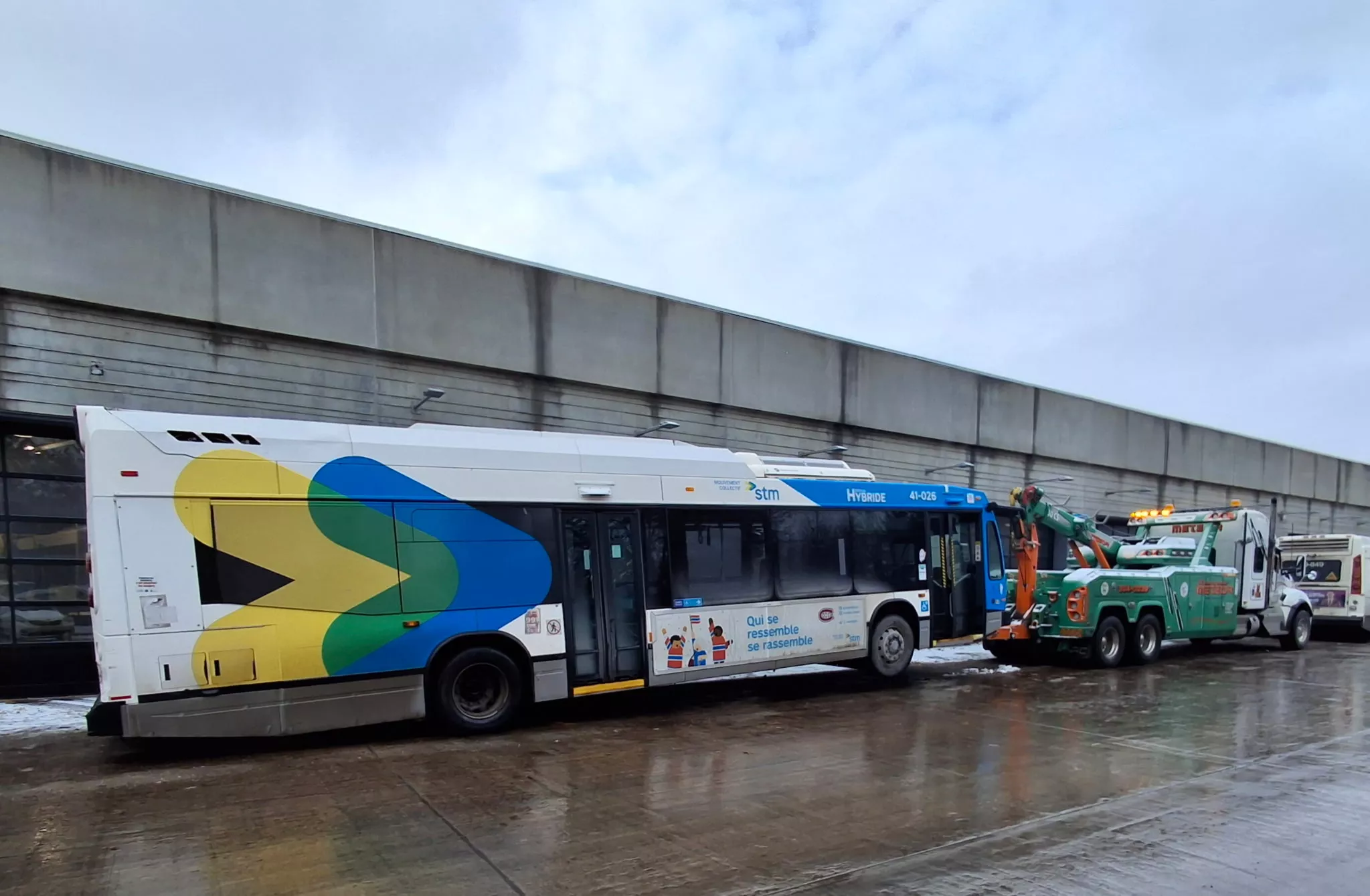
Buses are the most common type of electric heavy vehicle. (Credit : Remorquage Meteor)

Stéphane Ruel, training advisor, road operations, CAA-Québec. (Credit : CAA-Québec)

Yves Racette, director of program development at NAPA and Traction. (Credit : NAPA)

Electric trucks may still be rare on Canadian roads, yet they are now part of the landscape. And like any vehicle, they can break down or run into trouble. Their towing, however, calls for a specialized approach because the process carries a high degree of complexity.
At present, these quiet heavy trucks represent only a very small share of the calls handled by Remorquage Meteor, explains Serge Landry, co-owner and trainer for the Association des Professionnels du Dépannage du Québec (APDQ) and WreckMaster. The family business operates 54 tow trucks and covers a wide territory stretching from Quebec to the United States and across Ontario. Their units, equipped with rear-mounted lifting systems, usually haul between 40 and 50 tonnes.
Even so, the few trucks equipped with this “extremely rare” powertrain require tow operators to be especially vigilant. To help prevent errors, M. Landry teaches the SCÈNE method. S stands for scanning the area to assess the situation. C involves calculating the resistance and the actual capacity of the tow truck. E highlights the need to explain the procedure to everyone involved. N, meaning “no-nos,” refers to careful verification of attachment points. The final E stands for execution once everything is secure.
As with passenger vehicles, electric trucks should ideally be lifted onto a flatbed so the wheels stay off the ground and the electrical components are protected. The problem is that no flatbed tow trucks are available for heavy vehicles. “They could theoretically be loaded onto a lowboy trailer, although their deflectors make them far too tall. They will not clear the bridges,” says M. Landry. When transporting them is not an option, towing becomes the only solution.
While easier and quicker to perform, rear towing is not suitable for all trucks and is not recommended for electric models. Forward towing, however, involves additional steps to protect the drive motors. The first is to supply air to the vehicle that has broken down so the brakes can be released. This step requires some adjustment, “because once again, just as in the passenger-vehicle segment, the way to select neutral differs from one model to another,” says M. Landry.
This lack of standardization has implications for operator safety because tow professionals sometimes have to carry out manoeuvres they are not accustomed to. He gives the example of the 2025 Volvo models, where the air supply is connected directly to the air dryer located under the truck. The procedure instantly releases the brakes without anyone needing to climb into the cab to press the push button normally used for that task. It is therefore essential to block the wheels with chocks since the vehicle could move when the air returns. Depending on the truck model and the type of differential, the tow operator will then need to remove the driveshaft or the axles.
When it comes to personal protective equipment, it is largely the same as what is used with EVs, despite the higher voltage of heavy vehicles. “Grade zero gloves are obviously required,” explains Yves Racette, director of program development at NAPA and Traction, because “there is no way of knowing whether the vehicle has lost insulation.” Safety glasses are essential when it is time to remove the cab extensions. Since these parts are “not necessarily solid,” M. Landry recommends removing them when the truck is being towed from the rear. He adds that it is also possible to try securing the cab extensions instead. Otherwise, like an open parachute, they create drag and risk getting damaged, and the tow truck will burn more fuel to counter this effect. That is money straight out of the operator’s pocket, stresses M. Landry.
Constraints and Challenges
The procedure becomes even more complex when a truck ends up in a ditch or is involved in a collision. In such situations, the operator must take the time to understand the vehicle’s mechanical layout before intervening. “One of the first things to do, even before arriving on site, is to consult the manufacturer’s emergency response guide to understand how to partially disable the electrical system or even how to proceed with towing,” explains Stéphane Ruel, training advisor, road operations, CAA-Québec.
This practice, not yet standard among towing professionals, is just as relevant in the trucking world, he believes. Some vehicles also require a mandatory waiting period before any handling. M. Ruel adds that communication with first responders is essential to secure the area, share information and minimize risks for everyone.
Other challenges add to these constraints. There are still uncertainties regarding thermal runaway risks during storage and the vulnerable impact areas on these vehicles. On electric trucks, the batteries often occupy the space where the fuel tank used to be. “In a jackknife, everything ends up pressing into that area,” notes the co-owner of Remorquage Meteor.
The growing complexity of vehicles and the rapid pace of technological change require tow operators in Quebec to keep their training up to date. “We can no longer tow the way we did 20 years ago. It is not the same game anymore,” says M. Ruel. Although the industry does not have a formal curriculum, the Centre de formation en transport de Charlesbourg (CFTC) and the Centre de formation du transport routier de Saint-Jérôme teach the basics of the trade. These skills can then be expanded through programs offered by CAA-Québec, the APDQ or WreckMaster.
M. Racette points out that the value of preventive maintenance should not be underestimated. He believes a large portion of breakdowns results from insufficient follow-up. “We now have access to data that allows us to address certain issues,” and thereby reduce the risk of downtime. He considers the Preventive Maintenance Program (PEP) a solid foundation, yet he questions the depth of current inspections on electric trucks, especially regarding high-voltage systems.
Even though they remain marginal, electric heavy trucks bring their share of challenges. Interventions require more preparation, more knowledge and greater caution. Tow operators now work in an evolving environment and with technologies that require an even higher level of expertise.