

Federal Investment and Utility Innovation Drive EV Expansion
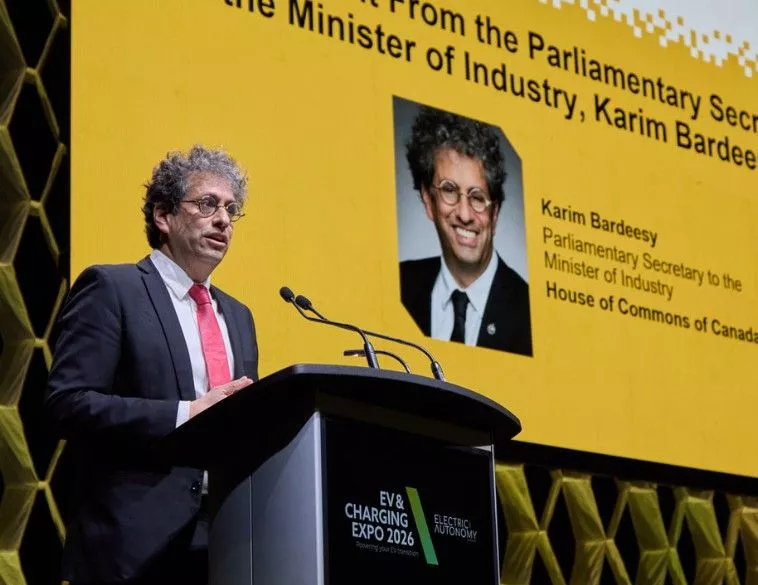
Karim Bardeesy, Parliamentary Secretary to the Minister of Industry, announces $10.6 million funding initiative. Credit: Jack Kazmierski

New funding for charging infrastructure and education programs, alongside Toronto Hydro’s pilot, target faster, more accessible EV adoption.
The EV & Charging Expo 2026 opened on April 8 with a series of major announcements from the federal government and key players shaping Canada’s electric vehicle landscape, setting an optimistic tone for the two-day event.
Following a panel discussion on the electrification of federal government fleets, Karim Bardeesy, Parliamentary Secretary to the Minister of Industry, took to the main stage to unveil a new federal investment in EV infrastructure. Speaking on behalf of the Honourable Tim Hodgson, Minister of Energy and Natural Resources, Bardeesy announced $10.6 million in funding for 14 charging infrastructure projects across the country.
The investment is expected to support the installation of more than 1,600 EV chargers nationwide.
“With today’s announcement, we are investing in EV chargers where Canadians need them most in Toronto and beyond, making it easier for drivers to get to where they live, work and play,” Bardeesy said. “This is how we build a strong and climate-competitive future.”
EV education efforts reach more communities
In addition to infrastructure funding, Bardeesy confirmed that Natural Resources Canada will extend its support for Plug’n Drive’s EVs Are for EVeryone Cross-Canada Tour. Backed by an additional $1.1 million, the program will continue delivering hands-on EV education in communities across the country, with a particular focus on small and mid-sized regions where adoption rates remain lower.
The initiative gives Canadians the opportunity to explore how electric vehicles fit into their daily lives, compare different models in one place, and connect directly with EV experts to have their questions answered.
Toronto Hydro pilot aims to cut costs and timelines
At the municipal level, Toronto Hydro also used the occasion to introduce a new pilot program aimed at accelerating the deployment of EV charging infrastructure across the city. The initiative will provide select projects with direct access to 480-volt power, which will both reduce costs and construction timelines.
Currently, most DC fast chargers operate at 480 volts, while utility-owned transformers typically supply 600 volts. This mismatch requires charging providers to install additional equipment to step down the voltage, and that’s an added expense that can delay project timelines.
Toronto Hydro’s pilot seeks to eliminate that barrier by offering up to 10 projects access to utility-owned 1.5 MVA, 480-volt transformers. Under the program, customers will cover the cost of the transformer, while the utility retains ownership and assumes responsibility for ongoing maintenance. The pilot is expected to run through the end of 2027.
“Toronto Hydro is proud to explore utility-owned 480-volt transformation as part of our ongoing efforts to support the growth of electric vehicle charging,” said Dan Smart, Interim Chief Operating Officer, Toronto Hydro. “As demand for EV charging continues to grow, our customers are looking for solutions that are streamlined, reliable and easy to implement. This pilot represents an important step in strengthening the infrastructure needed to support the city’s transition to electric transportation.”
Together, the announcements underscore a coordinated push—from federal funding to local innovation—to expand charging access, reduce barriers, and accelerate Canada’s transition to electric mobility.