
From Tragedy to Transformation
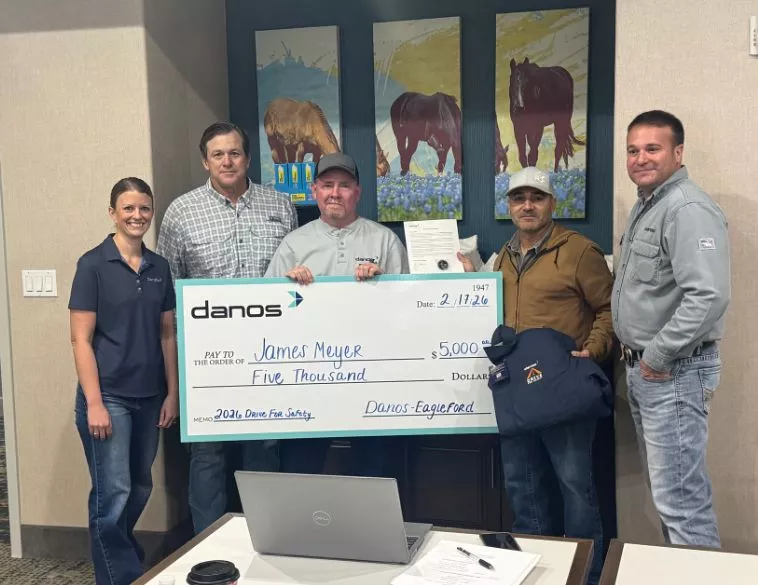
Danos’ 2025 “Drive for Safety” grand prize winner James Meyer was recently presented with his $5,000 cheque. (Credit : Danos)

How Danos rebuilt their fleet safety culture.
In 2012, Danos—a third-generation, family-owned energy services company operating across the U.S.—won a major contract with a gas and oil company. The new business fundamentally changed Danos’ fleet exposure.
What began as a modest operation of 20 to 30 trucks quickly grew into a dispersed, multi-state fleet often operating in remote terrain. Unlike Danos’ legacy operations, where vehicles and drivers were visible daily, these new assets operated far from direct oversight.
“We thought we had a good program,” says John Bigler, Quality Assurance & Asset Manager at Danos. “We had telematics. We had safety policies. Alerts were going to managers.”
However, something critical was missing. That gap became devastatingly clear when the company experienced a fatal accident which could have ended in a nuclear judgement.
“That was the moment,” Bigler says. “We had to ask ourselves, what’s going on here? We’ve got the technology. Why didn’t it stop this?”
Technology Without Accountability
Like many fleets, Danos had invested in telematics early. Alerts for speeding, harsh events, and seatbelt violations were already flowing to managers’ phones. But alerts alone didn’t create action.
“The policy said what we were going to do,” Bigler explains, “but we weren’t enforcing it.”
Managers received notifications—but there were no clearly defined roles, no corrective action ladder, and no accountability structure. When a driver sped, what happened next? Who made the call? What were the consequences? The answers weren’t standardized.
Danos’ Fleet Supervisor, Katie Smith, who works alongside Bigler, adds that the telematics system itself was also part of the problem. “We just accepted the default settings,” she says. “We treated it like a one-size-fits-all solution.”
Harsh braking and acceleration alerts were constant—often triggered by terrain realities in oilfield environments. The signal-to-noise ratio was too high. Managers were overwhelmed, and the most critical behaviours weren’t clearly prioritized.
Rewriting the Playbook
In late 2022, Danos began a comprehensive overhaul. First, leadership rebuilt the fleet safety policy from the ground up. Roles and responsibilities were clearly defined. Corrective actions were standardized. Enforcement was formalized and signed off by senior vice presidents.
If a driver exceeded policy thresholds, there would be a defined response: coaching, documented reports, required training, probation—or in severe cases, suspension of company driving privileges.
“We had to hold the line,” Bigler says. “Operations had to be willing to make the tough calls.”
Just as importantly, Danos simplified their telematics focus. Instead of chasing every alert, the company narrowed proactive intervention to two behaviours: speeding and seatbelt usage.
“We said, if we can’t prevent every accident, we can reduce severity,” Smith explains.
The company established internal parameters. While drivers are expected to obey posted limits, telematics intervention triggers at a defined threshold. Drivers hear an in-cab alert first, giving them time to self-correct. If they fail to do so, the account manager receives a notification and must call immediately.
Seatbelt alerts follow a similar logic. If a vehicle exceeds 10 mph without a seatbelt engaged for a defined duration, managers are notified. “We don’t chastise,” Bigler says. “We coach. But we call every time.”
Removing Subjectivity with MVR Monitoring
Telematics reform was only part of the solution. Danos also implemented continuous motor vehicle record (MVR) monitoring across approximately 900drivers.
Instead of relying on periodic manual checks—or subjective HR interpretation—the company introduced a points system aligned with insurer.
- Major Moving Violations: 6 points
- Minor Moving Violations: 2 points
- Moderate Moving Violations: 3 points
Drivers whose cumulative points exceed the threshold of 6 points lose driving privileges until they fall back below the acceptable threshold.
There’s no subjectivity anymore,” Bigler says. “The system decides.”
New hires do not receive fuel cards or vehicle keys until MVR clearance is confirmed. If a driver receives a violation, the fleet team is typically notified within five days.
Executive Buy-In as a Force Multiplier
Bigler is clear: none of this would work without executive commitment. Danos’ leadership team—including the CEO and senior vice presidents—reviews a detailed fleet report every month. The report includes:
- Total miles driven (15.3 million in the most recent year)
- Accident frequency and severity
- Accident and Telematic Violation rates per million miles
- Year-to-date KPI comparisons
- Zero telematics infractions
- Zero accidents
- Clean MVR status
- No remedial training
“When it’s important to your boss, it becomes important to you,” Bigler says.
Fleet safety metrics are embedded into leadership KPIs. Trends are questioned. Spikes are investigated.
The financial impact has been dramatic, with accident costs—including property damage and bodily injury—decreasing by 82% from 2023 to 2025.
While total accident counts have decreased roughly 20% over two years, the real shift is in severity. Major injury crashes have been largely replaced by low-impact incidents, such as minor backing events and animal strikes. “That’s the difference,” Bigler says. “We’re reducing severity.”
From Reactive to Proactive
In 2024, Danos added another layer: positive reinforcement.
The “Drive for Safety” campaign recognizes drivers who complete a full month—or full year—with:
Monthly regional winners are entered into a draw for $500. Annual qualifiers are entered into a $5,000 grand prize drawing.
Recognition goes beyond cash. Winners receive jackets, formal letters, and public acknowledgment across company communications. The CEO or president personally calls winners to thank them, and personally flies out to meet the winner of the annual prize.
“It’s not just about pointing out negatives,” Smith says. “We celebrate the guys doing it right.”
The cultural shift is evident. Drivers now call proactively to ask whether a minor incident disqualifies them from the draw.
Integration and Data Visibility
A key enabler of Danos’progress has been consolidating previously siloed systems—fuel management, telematics, maintenance, and reporting—into a unified fleet management platform through Holman.
“Holman played a significant role in our success,” Bigler says.
“Before Holman we were very siloed, working out of six or eight different programs,” Smith adds, “and getting the information would take way too long.”
Previously, gathering annual metrics required weeks of manual aggregation across multiple portals. Now, comprehensive reports can be generated within days. “You can’t manage what you can’t measure,” Bigler says. “The visibility changed everything.”
Advice for Other Fleets
For fleet professionals looking to replicate Danos’ results, Bigler and Smith emphasize five core principles:
- Start at the top. Executive buy-in must be visible and sustained.
- Define accountability. Alerts without defined action steps are meaningless.
- Focus on severity. Identify the behaviours that matter most.
- Remove subjectivity. Use point systems and KPIs to standardize decisions.
- Break it into components. Tackle telematics, MVRs, training, and policy step-by-step.
“You eat an elephant one bite at a time,” Bigler says.
Above all, he returns to the human cost that initiated the transformation. “The worst thing you ever have to do is tell a family their loved one isn’t coming home,” he says. “If you feel that pain once, you don’t want to feel it again.”
For Danos, fleet safety is no longer just a program. It’s a measurable, executive-driven discipline—one that protects drivers, strengthens operations, and proves that technology works only when accountability follows the alert.