
More Muscle, More Choices
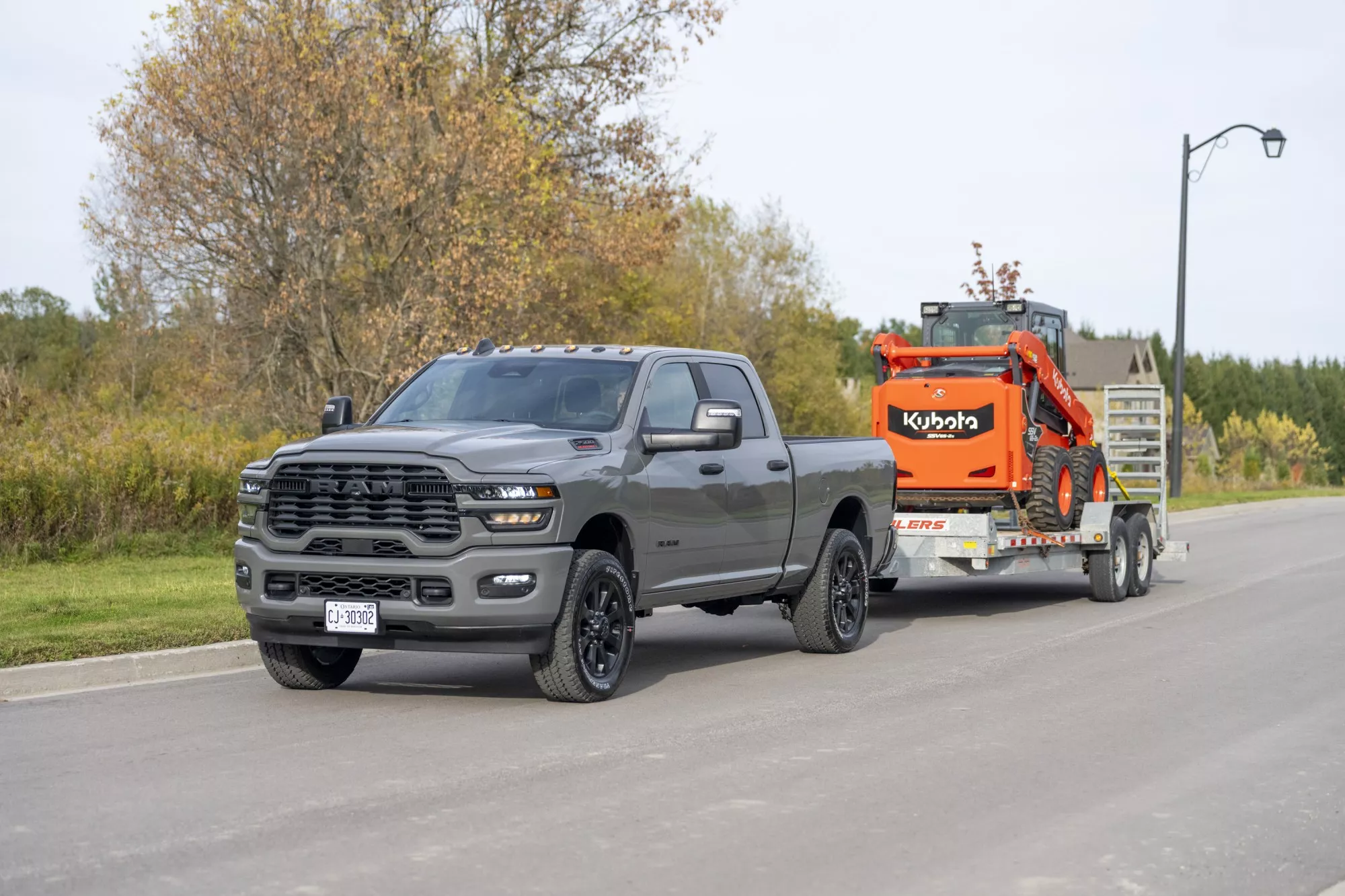
The event provided an opportunity to experience Ram’s towing capabilities. Credit: Stellantis

The Hemi V8 returns, heavy-duty models gain new options, and the ProMaster City is set to make a comeback.
Uxbridge, Ont. - The popularity of trucks among consumers is a benefit for fleets. Trucks used to go years without changing, but competition for consumer sales now means regular updates and wider choices. Ram recently showed its lineup of light- and heavy-duty trucks to media at a driving event, along with news of a new ProMaster van coming down the pipeline.
What’s new with Ram’s trucks?
For the 2026 Ram 1500, the 5.7-litre Hemi V8 is available again. It was discontinued for a year in favour of a six-cylinder-only lineup, but customer outcry was loud enough to bring it back. It comes standard with a sport exhaust and with eTorque, which was previously optional. This 48-volt, self-charging mild hybrid system assists with starting the engine and increases fuel efficiency, but the truck can’t drive on electricity alone.
A 360-degree camera is now standard on upper truck trims; and V6-equipped models offer optional 2-kW onboard power with two bed-mounted 120-volt outlets. And while not on most fleets’ radar, for 2027, Ram also brings back its high-performance trucks, including a new Rumble Bee and 777-horsepower TRX SRT.
The heavy-duty models are basically unchanged for 2026, but for 2027, the 2500 Power Wagon will be available with a diesel, and a new optional upgrade package available on most Ram 2500 V8 trims will provide up to 4,580 lbs of payload. A pursuit-capable 2500 emergency response vehicle will also be available for fleets.
Ram truck powertrains and configurations
The Ram 1500 comes in Quad Cab or Crew Cab, and while it’s 4x4-only for consumers, some trims are offered in 4x2 for fleets. The engine lineup, with availability depending on trim, is a 3.6-litre “Pentastar” V6 at 305 horsepower and 269 lb-ft of torque; 5.7-litre Hemi V8 at 395 hp and 410 lb-ft; 3.0-litre “Hurricane” turbocharged inline-six at 420 hp and 469 lb-ft; and 3.0-litre high-output at 540 hp and 521 lb-ft, all with eight-speed automatic transmission.
The Ram 2500 and 3500 come in Regular Cab, Crew Cab, or Mega Cab, with a longer cab for extra rear-seat legroom and storage. Engine choices are a 6.4-litre Hemi V8, making 405 hp and 429 lb-ft; or 6.7-litre Cummins high-output inline-six turbodiesel for 430 hp and 1,075 lb-ft, both with eight-speed automatic. The heavy-duty is also available as a chassis cab, strictly with the Cummins diesel and as the 3500, 4500, and 5500.
Ram truck capability and features
Towing capacity obviously depends on configuration, and in the Ram 1500, with engine availability in the various trims. Overall, with the V6, maximum towing is 8,100 lbs; the I6 is 11,470 lbs; the high-output I6 is 9,480; and the V8 goes up to 11,530 lbs.
For conventional towing, the 2500 goes as high as 17,710 lbs with the V8 gas engine, and 20,000 lbs for the diesel. The 3500 tops out at 18,110 lbs with gasoline and 23,000 lbs with diesel. For fifth-wheel/gooseneck towing, maximum on both is 18,150 lbs with gasoline, and 36,610 lbs for diesel.
Available towing assist features include hitch-up camera assist, telescoping mirrors with power convex mirrors, trailer reverse steering (which doesn’t need stickers on the trailer with conventional towing), 360-degree camera, and a digital rearview mirror with tow mode. That can split into two views, showing what’s on either side of the trailer; and into three including what’s behind it, if there’s an optional camera on the trailer.
The Cummins further includes a two-stage exhaust brake. “We came out with it first,” said George Vudrag, Vehicle Synthesis Manager for Ram HD Engineering. “You get the full exhaust brake when you touch the button; the second press gives the auto exhaust brake, (which) maintains your speed down a grade.” Once it’s activated, you set your speed, either by braking or letting off the throttle, and the exhaust brake keeps it there. Vudrag also noted the optional rear air suspension on the heavy-duty models, which he said is class-exclusive. Its two modes include auto-levelling to keep the trailer straight, and an alternative height that drops the truck’s rear end by an inch to make it easier to hook up a conventional or gooseneck trailer.
Driving impressions
The event was an opportunity to drive all engines, including with conventional and gooseneck towing, along with off-road driving. All have excellent driving manners and a comfortable ride. The 1500 and 2500 use rear coil springs, unless replaced with optional air suspension that’s four-corner on the 1500 and rear on the 2500. The 3500 uses two-stage leaf springs, replaced by smaller springs if air-equipped. The cabins are well-finished and the seats are comfortable.
All engines are impressively smooth performers, including the V6 that will be a good choice for lighter duty with fuel efficiency. The turbocharged inline six-cylinder choices are surprisingly strong, including when towing, although note that premium fuel is recommended in the standard version and required in the high-output. All remained composed during towing, and even when heavily loaded, the front tires stay planted and maintain their grip.
A new ProMaster is coming
Ram also showed a ProMaster van converted for mobility transit. The full-size ProMaster comes in 1500, 2500, and 3500 configuration, three wheelbases, and three roof heights, plus a cutaway; and all use the 3.6-litre Pentastar V6, here making 276 hp and 250 lb-ft of torque. It’s the only FWD van in the segment, giving it lower step-in height.
While we’ve yet to see it in person, the ProMaster City returns for 2027, now a midsize rather than compact as before. It’s only slightly shorter than the full-size ProMaster, but with a maximum of 1,947 mm (76.7 inches) of roof height, it’s designed for limited-height spaces. It uses a 1.6-litre turbocharged four-cylinder, making 166 hp and 221 lb-ft, with an eight-speed automatic and FWD. It will come as a passenger or cargo van, with 180-degree swing-out rear doors or optional liftgate, and with targeted 2,000 lbs for both towing and payload. In Canada, it will start below $45,000, and we’re looking forward to driving it to see what it’s all about.