
Electric Truck Market Analysis and Supply Chain Outlook to 2032
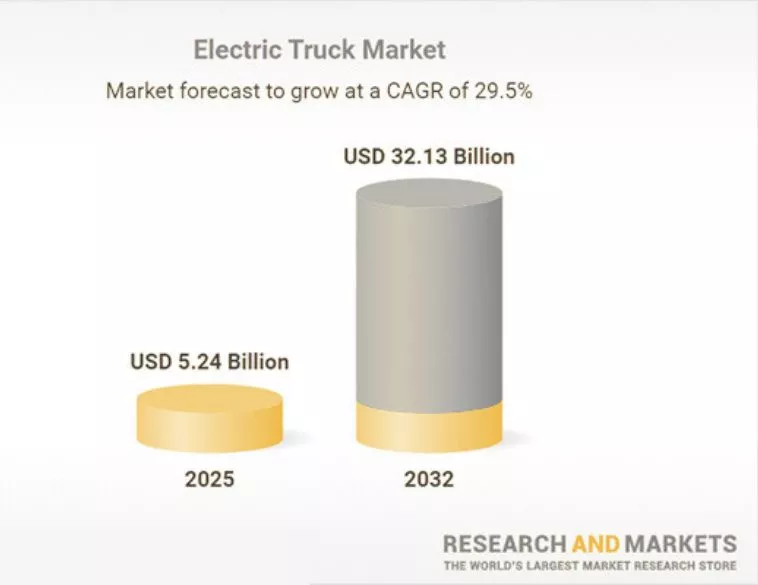

The electric truck market is anticipated to grow at a CAGR of 29.5%, reaching USD 32.13 billion by 2032 from USD 5.24 billion in 2025. The increase in medium-duty electric trucks is driven by stringent emission regulations and operational benefits for urban and regional delivery. Cities globally are implementing stricter vehicle emissions limits, bolstered by the rise of medium-duty trucks used for last-mile delivery. Electric trucks between Class 4 and Class 6 offer a zero-emission solution, meeting regulatory goals and supporting low-emission zone initiatives.
Reduced noise levels make these trucks ideal for off-peak deliveries in urban locations. Companies like Ford and BYD have introduced medium-duty electric models designed for urban freight and field services. These trucks typically cover 150 to 200 miles per charge, sufficient for daily operations, and offer a lower total cost of ownership. Fleet operators are increasingly adopting these vehicles as sustainable and strategic assets, aligning with corporate ESG goals.
The market is dominated by key players like BYD, AB Volvo, Ford Motor Company, Daimler Truck AG, and Dongfeng. The report segments the market based on propulsion, type, battery type, end users, range, payload capacity, and region, focusing on BEV, PHEV, and FCEV technology.
Long-range Electric Trucks to See Fastest Growth
Trucks with ranges above 200 miles will experience significant growth as fleet operators demand long-range solutions for regional logistics. This growth is supported by advancements in battery technology, with models like Tesla Semi and Freightliner eCascadia demonstrating extended capabilities. Long-range electric trucks are increasingly used in intercity transportation, contributing to productivity and cost efficiency.
The rapid segment growth is bolstered by investments in high-capacity charging infrastructures, especially in the US, Canada, and Europe, where public and private initiatives are accelerating infrastructure deployment. Major logistics providers like PepsiCo and DHL are already exploring long-range electric trucks for operations.
Stricter carbon regulations and incentives for zero-emission vehicles create favorable conditions for fleet transitions, making long-range electric trucks a valuable addition. As battery prices decline and range anxiety decreases, these trucks provide a compelling solution for decarbonizing operations without sacrificing logistical scope.