
Alternative Fuels at the Heart of Discussions
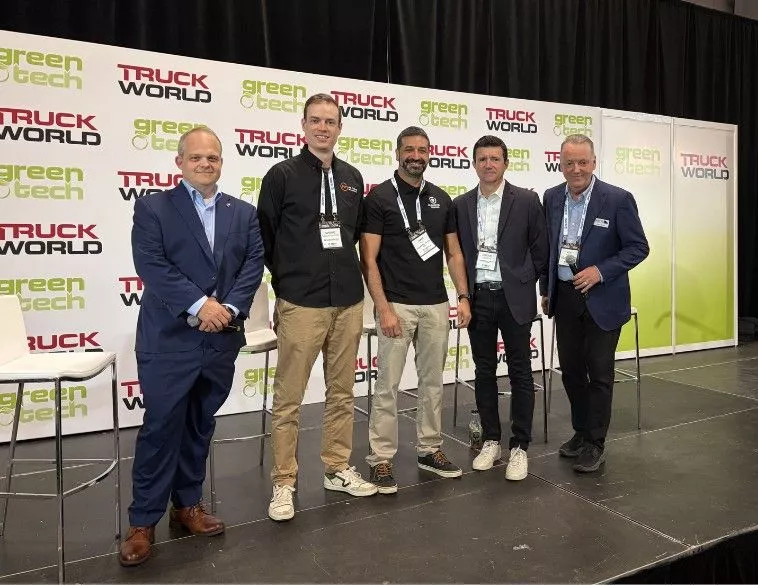
A panel of experts addressed the issue of alternative fuels. Credit: Michel Beaunoyer

Fuel management is one of the most significant expense items for fleet managers. At the Truck World show, a panel of experts specifically addressed the future of freight transport from this angle.
Johan Agebrand of Volvo Trucks North America, Jamie Ally of Elemental Trucks, Jérôme Grégeois, Commercial Vehicle Director at the Hyundai Technical Centre, and Maxime Tanguay-Laflèche of the PIT Group research centre discussed this topic, moderated by Ken North of NACFE.
What these experts seem to agree on is that for fleet managers, the opportunities to switch to an alternative fuel in heavy-duty transport are real. Class 8 trucks running on electricity or hydrogen-powered fuel cells are available today, but they do not meet all needs or present supply challenges. This was illustrated by zero-emission fuel cell technology.
For a dozen years, Hyundai has been offering hydrogen-powered heavy-duty transport solutions. The challenge is gaining access to refueling stations. The most successful applications are in industrial or port areas where private refueling stations are accessible. In Canada, outside of British Columbia, there are hardly any public refueling stations, and private initiatives are anecdotal.
The electric heavy-duty truck seems more appealing but remains subject to range constraints. "And our studies show that this range is reduced by 25% in winter," notes Tanguay-Laflèche, whose firm completed a comparative study (https://library.fpinnovations.ca/list?q=&p=1&ps=20&sort=title_sort%20asc&researcharea_facet=PIT) on heavy-duty electric trucks last March. "Obviously, if drivers demonstrate good driving practices and use regenerative braking, the loss will be smaller."
According to Agebrand of Volvo, manufacturers are constantly pushing to increase the range of electric trucks, but the ideal application right now remains regional delivery with overnight charging at the customer's warehouse or headquarters.
Another alternative discussed is the use of biodiesel. Here again, it is all a question of availability. Biodiesel is produced from vegetable oil, used cooking oil, or plant biomass.
"The great advantage of this alternative and renewable fuel is that it can be used in heavy-duty trucks without modification to the conventional engine," points out Agebrand. It is, according to him, an interesting approach for fleet managers who want to transition towards greener transport while waiting for technological solutions that better correspond to their reality, which will replace the proven combustion engine.
All in all, as Tanguay-Laflèche summarizes, before choosing replacement commercial vehicles, managers must "do their homework" by looking at the various options applicable to their operations.
To which Agebrand adds: "For the time being and in the foreseeable future, the alternative fuel solution is not unique. Heavy-duty transport will rely on a combination of technologies. The important thing, in my opinion, is not to wait for the future but to create it by putting these technologies to the test."