
NRCan Updates SmartDriver Program
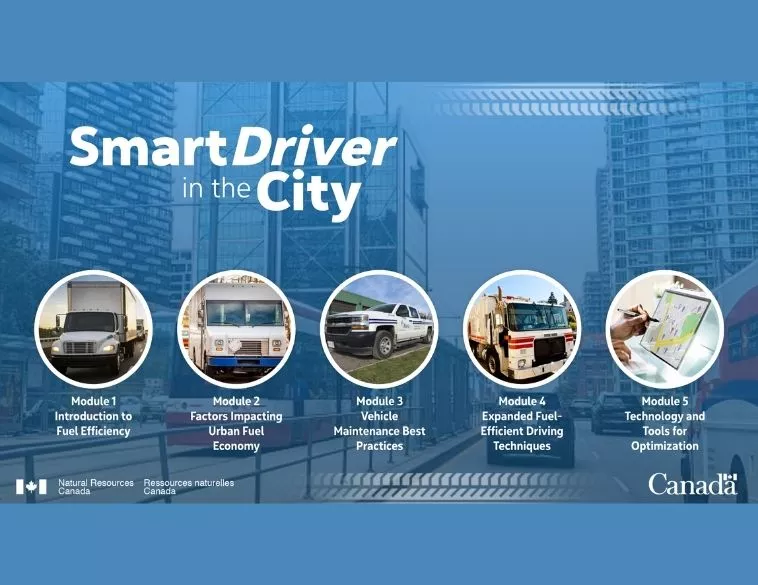

Natural Resources Canada has launched a redesigned SmartDriver in the City course, providing fleet drivers and managers with practical strategies to improve fuel economy, reduce emissions and enhance road safety.
Natural Resources Canada (NRCan) has launched a newly modernized version of its free SmartDriver in the City training program, giving professional drivers and fleet managers a more engaging way to learn fuel-efficient driving techniques, improve safety, and reduce operating costs.
Released on June 8, the updated course is aimed at professional drivers, as well as managers of urban and municipal fleets. It provides practical guidance on reducing fuel consumption, lowering emissions, and improving vehicle performance in city driving environments.
According to Robert Gaudin, Program Officer with NRCan’s On-Road Transportation Division, the course itself is not new, but the learning experience has been significantly upgraded.
“We wanted to modernize it,” Gaudin explains. “Instead of just reading multiple pages in a PDF format, the modules are now more interactive with images and a quiz at the end.”
The redesigned SmartDriver in the City course is now hosted on NRCan’s SmartDriver online learning platform and can be completed in approximately 45 minutes. The curriculum is divided into five modules covering key aspects of urban fleet operations:
• Introduction to fuel efficiency – An overview of fuel-efficient driving principles and how driver behaviour affects fuel consumption
• Factors impacting urban fuel economy – Examines the effects of traffic congestion, route planning, weather conditions, and idling on fuel use
• Vehicle maintenance best practices – Covers maintenance items such as tire pressure, filters, and wheel alignment that support fuel economy, reliability, and lower operating costs
• Expanded fuel-efficient driving techniques – Practical strategies including progressive braking, maintaining momentum, and other efficiency-focused driving habits
• Technology and tools for optimization – Explores telematics, GPS systems, driver-monitoring technologies, and other tools that can help improve fleet performance
Growing adoption across Canada
The SmartDriver program has already gained significant traction within the transportation industry. According to Gaudin, thousands of professional drivers and fleet personnel have completed the various training modules since the program was introduced.
“Since it was created in 2017, over 16,000 user accounts have been created, and nearly 20,000 course enrolments have been recorded,” he says. “These include commercial truck drivers, owner/operators, driving schools, municipalities, utility companies, construction fleets, and more.”
Certification and flexible delivery
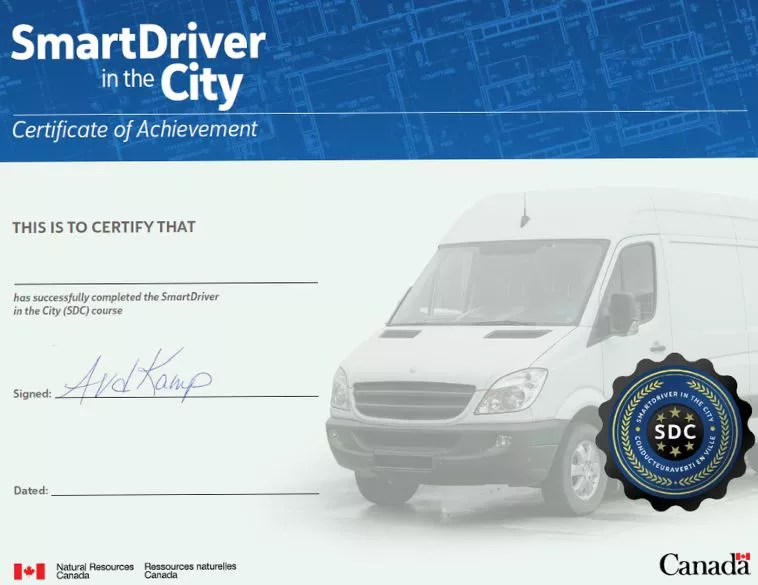
Participants who successfully complete a course and pass the associated quiz receive a certificate of completion, which can be submitted to employers as proof of training.
Although the courses are designed for self-paced online learning, fleets also have the option of delivering the training in a group setting.
“If you’re a fleet manager,” says Gaudin, “you can give the training to all your employees at the same time in a class setting. That way you can be sure that they’re taking it. But if you want them to do it on their own, then we offer a certificate of completion.”
This flexibility allows organizations to integrate the training into existing onboarding, safety, or professional development programs.
Positive results in the field
Feedback from fleet operators has been overwhelmingly positive, with many reporting measurable improvements after implementing the training.
Gaudin says fleet managers frequently reach out to share their experiences and highlight the operational benefits they are seeing.
“A lot of the feedback has to do with improved fuel economy, improvements in driving habits, reduction in idling, along with smoother acceleration and braking,” he says. “Drivers also appreciate that they can take what they have learned and apply it on the road immediately.”
Fleet operators report that the training has helped reinforce fuel-efficient driving behaviours while supporting broader goals around cost reduction, safety improvement, and emissions reduction.
A growing suite of SmartDriver programs
The SmartDriver in the City course is the latest addition to NRCan’s broader SmartDriver training portfolio, which includes programs tailored to several transportation sectors:
SmartDriver Training: Highway Trucking
• Module 1: Why fuel-efficient driving matters
• Module 2: Physical factors that affect fuel efficiency
• Module 3: Fuel efficient driving
• Module 4: Vehicle care and inspection
SmartDriver Training: Work Truck
• Module 1: Introduction and why fuel efficiency matters
• Module 2: Buying and spec’ing the right truck
• Module 3: Fuel-efficient driving practices and jobsite operation
• Module 4: Telematics
SmartDriver Training: Forestry Trucks
• Module 1: Introduction
• Module 2: Smart Driving in the Forestry Sector
• Module 3: Basic Principles for Defensive Driving
• Module 4: Driving for Fuel Efficiency
• Module 5: Spec’ing a Truck
• Module 6: Basic Maintenance Knowledge
• Module 7: Conclusion
SmartDriver Training: School Bus
• Module 1: The SmartDriver – Includes information on pollution, fuel technology and the value of rest, exercise and nutrition
• Module 2: About your vehicle – Teaches drivers about vehicle technology and maintenance, as well as operating techniques to improve fuel efficiency
As fleets across Canada continue to face rising operating costs, increasing sustainability expectations, and ongoing pressure to improve safety performance, driver training remains one of the most cost-effective tools available.
By modernizing SmartDriver in the City and expanding access to practical, industry-specific training, NRCan is helping fleets equip drivers with the knowledge and habits needed to improve efficiency behind the wheel.
For many organizations, even small gains in fuel economy and reductions in idling can translate into significant savings when applied across an entire fleet.