
Englobe: a strategic fleet approach to support growth
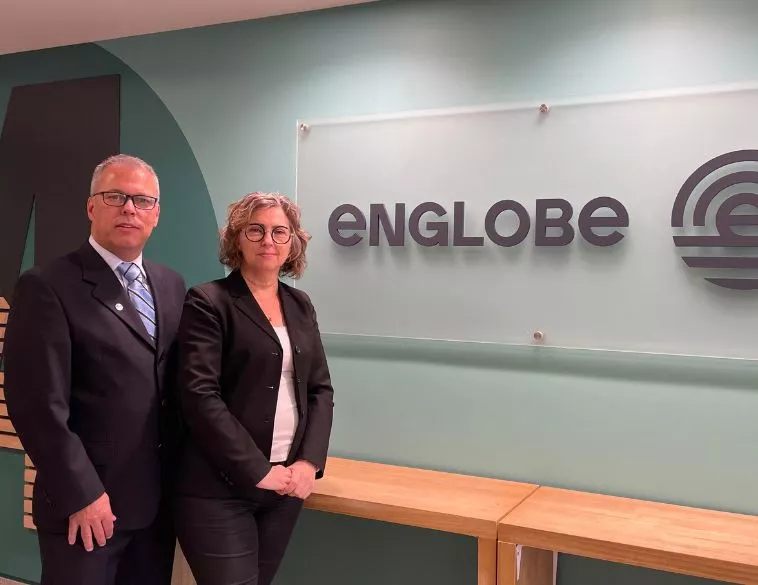
Stéphane Bisaillon, corporate fleet manager, Real Estate Management and Procurement, and Nancy Mercier, corporate coordinator at Englobe. (Credit : Englobe)

Englobe, one of Canada’s six largest engineering and environmental services firms, carries out more than 25,000 projects every year. (Credit : Englobe)
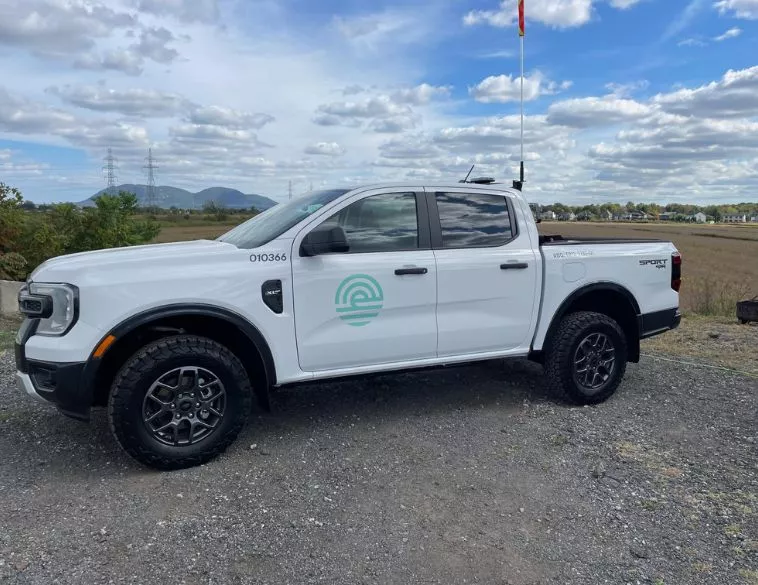
Ford pickups remain the most common models across Englobe’s fleet. (Credit : Englobe)

Englobe has been expanding at an impressive pace, and now employs more than 3,400 team members across Canada. The company, which specializes in engineering and environmental services, continues to grow through a steady stream of acquisitions.
A centralized fleet management strategy became essential to support that expansion. “When you bring in a new company, you also bring in its culture and its fleet,” says Stéphane Bisaillon, corporate fleet manager, Real Estate Management and Procurement at Englobe. He joined the company four years ago, at the same time Englobe created a department dedicated to managing the roughly 350 vehicles operating across the country. His arrival also marked the start of a five-year replacement plan aimed at reducing breakdowns, improving fuel efficiency, increasing reliability and limiting downtime. The plan, based on a 20 % annual renewal rate and a target ownership period of five to seven years, was “developed jointly with Finance, Legal, Human Resources and Operations” and is now close to adoption.
Previously overseen by the operations branch, the logistics of the entire fleet now rest with a team of two. M. Bisaillon, supported by Nancy Mercier, corporate coordinator, was tasked with building a structure that would “allow internal clients to spend as little time as possible on fleet administration. My job is to implement policies, establish guidelines, support employees, give them the tools they need and guide them toward a unified corporate culture,” he explains, “instead of having everyone manage their vehicles on their own.”
Preparing for a major refresh
Because the company lacked a structured approach in the past, several divisions or operational centres (OCs) are still using vehicles that are ten or even twelve years old, with 200,000 to 300,000 kilometres on the odometer. “Without a replacement plan, they keep breaking down, and progress becomes impossible.” Regular replacement, along with newer technologies, quickly results in fuel savings and a reduced environmental footprint.
Starting from what he describes as an “almost” blank page, M. Bisaillon has been working to “review and simplify processes” by centralizing operations related to these essential tools that support project delivery. He also ensures that each operational unit receives the vehicle or vehicles best suited to its activities. That requires careful analysis, as the company operates across multiple sectors such as transportation, building, environmental services, energy and water.
Despite the wide range of conditions the fleet operates in, M. Bisaillon maintains that it is “relatively easy to manage.” About 85 % of Englobe’s units are Ford pickups, including the F-150, F-250, Ranger and Maverick. Only a small proportion are SUVs or full-size vans. “A key challenge is that many vehicles do not operate in urban areas or keep regular daytime schedules. Some can even be on the road for two or three weeks at a time.”
Given those realities, full electrification is not a viable option at the moment. “Once we have 1,000 kilometres of battery range, we will be able to deploy EVs throughout the company without operational constraints.” For now, M. Bisaillon estimates the electric potential at 50 vehicles, with just over half of them (26) suitable as fully electric models. As a result, the company is currently turning to hybrid powertrains.
An essential assessment tool
He relies on the Electric Vehicle Sustainability Assessment (EVSA) to evaluate potential. This tool compiles the data collected over the past twelve months through the integrated management system, which includes vehicle telematics. M. Bisaillon adds that working with the company’s fleet management partner, Holman, also reduces labour requirements. Without that support, his department would need at least five additional staff members to maintain the current workload.
Total Cost of Ownership (TCO), Right Sizing and shorter life cycles are key factors in procurement planning. TCO is “an indicator that motivates me. It’s a great tool because it allows me to challenge people’s assumptions about operations. When you show them the numbers, those facts speak for themselves.” Each vehicle must demonstrate value and support the fleet’s operational needs. To meet that objective, M. Bisaillon sometimes relies on seasonal or short-term rentals ranging from 6 to 24 months. At the moment, about 50 units, or roughly 14 % of the fleet, are managed this way.
Fleet management is too often overlooked, even though it directly affects efficiency, operating costs and profitability. For M. Bisaillon, it is time to recognize fleet management for what it is, a strategic tool that supports day-to-day operations and helps improve energy efficiency.