
A Popular Choice: Ford Pro’s Emergency Fleet Vehicles & Solutions
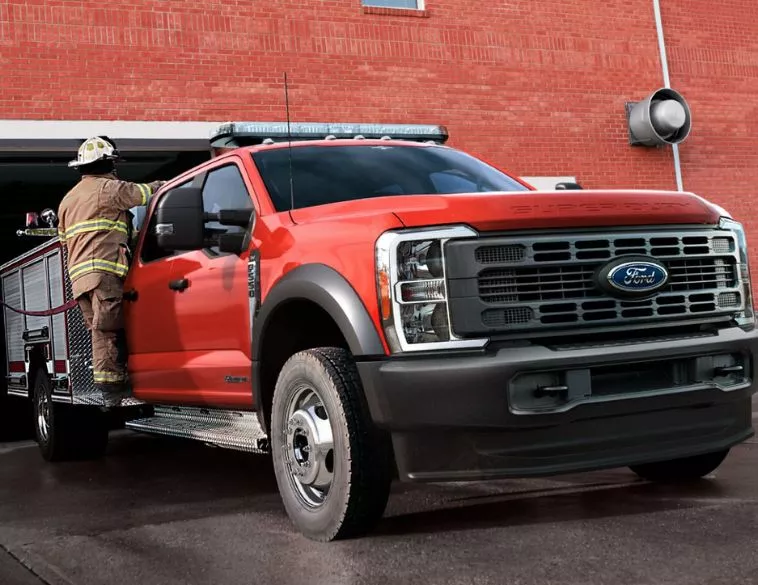
Ford’s F-Series Super Duty Chassis Cabs have consistently proved to be a top choice for emergency/fire/rescue fleets. In the U.S., they boast more than 50% market share. (Credit : Ford Pro)

The E-Series chassis cabs are one of the most popular choices for ambulances in Canada and the U.S. (Credit : Ford Pro)

A range of options and technology has continued to establish the brand as a market leader in the emergency vehicle space.
Emergency Services operate under some of the toughest conditions imaginable. They need reliable, dependable vehicles that are ready to go at a moment’s notice. They also need vehicles that are capable of and able to sustain high speeds, can be driven safely at those speeds, and are able to idle for extended periods. Emergency fleets also need to work with OEMs that offer flexibility when it comes to not only pricing but also specifications, including weight requirements, powertrains and upfitting.
Preferred source
In North America, Ford Motor Company has long been a preferred source for many emergency fleets including police, fire/rescue and ambulance operators. In this article we wanted to explore why these vehicles are so popular and what Ford Pro offers fleet customers when it comes to emergency vehicle procurement and support.
According to Matthew Drennan-Scace, truck and commercial, Ford Pro and sales Communications Manager for Ford Motor Company of Canada, a key reason for Ford’s popularity in the commercial fleet segment is having a lineup of vehicles that are easy to customize and upfit and are designed to cater to a variety of vocational uses. Additionally, says Drennan-Scace, Ford offers specific prep packages for fleet clients “based on what our customers have told us they need and value.”
Looking at emergency services specifically, Ford Pro offers prep packages for ambulances and fire/rescue vehicles. “These prep packages are a result of what first responders have told us they need in order to do their jobs safely,” explains Drennan-Scace.
Ambulance prep package
On the medium-duty side, for vehicles above ½ ton payload capacity, Ford offers an Ambulance Prep Package on XL and XLT F-Series Super Duty Chassis Cabs, that can be spec’d with either the 7.3-litre gasoline V8 or the 6.7-litre Power Stroke V8 turbo diesel. For these packages, Ford offers a Stationary Elevated Idle Control (SEIC) feature that’s integrated with the engine control module. Because it enables the engine to turn over at higher rpm when the vehicle is stationary, it allows the alternator to crank out higher amperage, enabling more Direct Current to power emergency upfit accessories.
Nevertheless, Drennan-Scace notes that further manufacturer and certification is acquired by a final-stage manufacturer to add this feature, though it does preserve the factory vehicle warranty for Ambulance Upfits. Alongside the Super Duty F-Series Chassis Cabs, Ford also provides an upfit package for its long-running E-Series van-based chassis cabs equipped with the 7.3-litre gasoline V8—another very popular foundation for ambulances in North America.
Major market share
Ford’s line of medium duty commercial vehicles and Ford Pro solutions have been a big hit with emergency fleets. In the U.S. for which data is available, more than 50% of medium duty emergency vehicles are based on the F-Series Super Duty chassis cab, compared with rival offerings in this market segment. In Canada [although specific data was not available at the time this article went to press], Ford has and continues to be a popular choice for emergency vehicle upfit and service use.
“At Ford Pro, our objective is to deliver the right vehicle for the right job, whether it is Super Duty, E-Series, Police Interceptor Utility, or something else,” says Drennan-Scace. He attributes the success of Ford in the emergency vehicle segment to having a wide range of customizable options when it comes to vehicles and upfits, “along with decades of expertise and the new Ford Pro Intelligence suite of services that keep customers coming back to us for their emergency vehicle needs.”
A Full Range of Solutions
While having the right vehicle is essential, it’s only part of what today’s fleet customers require when it comes to OEM partnerships. In today’s demanding operating environment, fleets are looking for solid solutions and support from beginning to end. At Ford Pro, Drennan-Scace notes that the approach is to offer a complete one-stop solution. This includes “offering integrated vehicles, software, such as Ford Pro Telematics and the available Vehicle Integration System 2.0, charging, financing, and service solutions like Mobile Service.” These are all designed to “help commercial customers maximize uptime, accelerate productivity, and lower total cost of ownership,” he explains.
Additionally, with the Ford Pro Vehicle Integration System 2.0, fleets can gain easier signal access to hundreds of vehicle signals. This helps ensure that upfits can easily and seamlessly integrate with the Super Duty chassis cab base, including the vehicle’s digital displays. “Over the air updates allow for this functionality to grow during the program year and beyond,” says Drennan-Scace.
Furthermore, upfitters can create a soft button in the truck’s centre display. This enables operators to control the added upfit equipment from the Sync screen inside the cab, as well as being able to see or display critical operating information when the vehicle is in use. In addition, the Ford Pro Vehicle Integration System 2.0 uses connected, cloud-based software to enable high levels of customization as well as safety interlocks. “Upfitters can store installation specifications via the cloud and help improve their installation experience over time,” says Drennan-Scace.
For emergency services, solutions such as Ford Pro’s Telematics Essentials provide a complimentary and easy to use tool that’s designed to optimize uptime by providing real-time vehicle health alerts through engine diagnostic codes and schedule maintenance.
Drennan-Scace notes that many software products offered by Ford Pro are also compatible with Ford via activated modems and non-Ford vehicles via a plug-in device.
“When combined with Ford Pro Telematics, fleet managers can manage a fleet of vehicles from various manufacturers with various powertrains through Ford Pro’s suite of telematics tools,” he explains.
Two other features that are noteworthy, are Ford Pro Intelligence in which products using this technology gather manufacturer grade vehicle data via the cloud. Fleet customers receive this information through the web-based application in which they subscribe, such as Telematics or Telematics Essentials. For non-subscribers, Ford Pro Data Services can also provide customers information through an API, either directly or through the customers' existing service providers.
Fleet Start Inhibit, activated with the Vehicle Security subscription, provides fleet customers the ability to protect their vehicles by allowing them to restrict or de-restrict driving. “A fleet manager can either set a schedule which is sent to the vehicle for when the vehicle is inhibited like overnight in a depot or send an inhibit command if abusive behavior is detected,” says Drennan-Scace. “The objective of this feature is to reduce losses from theft or misuse,” —an important consideration for emergency services and any fleet operator in today’s environment, where the concept of “time is money” has arguably never been more critical.