

Electric heavy-duty trucks: charging challenges and opportunities for fleets
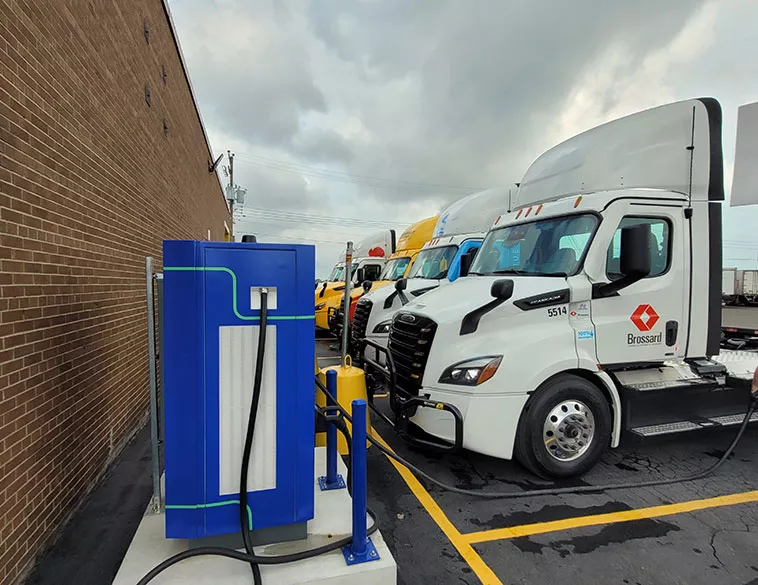

Long confined to short-haul routes, electrification is now gaining ground in medium- and long-distance segments, driven in particular by lower operating costs, financial support programs and carbon credits revenue.
A recent Propulsion Québec analysis of the Québec–Toronto freight corridor provides Canada’s first assessment of the feasibility of fully electric long-haul transport.
Real-world range and operational constraints
According to the study, an electric heavy-duty truck consumes an average of 1.9 kWh/km. Observed real-world range varies from 160 to 300 km, depending on temperature, payload and topography. These variables require a new level of operational discipline, with greater emphasis on energy planning, precise charging sequencing and careful management of downtime windows.
These operational requirements align with what many fleet operators are already seeing in the field: smart planning and the use of specialized software make a significant difference in the day-to-day operation of electric trucks.
Charging corridors, the cornerstone of electric interregional transport
Along the Québec–Toronto corridor, 71 charging sites have been identified, but none are currently suitable for Class 7–8 trucks. A telematics analysis conducted with Attrix across 1,000 daily stops identified seven priority sites.
The modelling shows that a fully electric trip is only achievable when charging is structured. On certain critical segments and under the most demanding conditions, range can be affected substantially.
The conclusion is clear: without dedicated charging corridors, long-distance electric freight transport will remain limited.
Emerging models in North American and European corridors
In California, Greenlane is deploying charging hubs based on telematics flow analysis. Terawatt, meanwhile, is developing hubs along Interstate 10 capable of delivering up to 1,000 kW and serving as many as 125 trucks per day. In Europe, BP Pulse is investing in port corridors equipped with ultra-fast charging.
These initiatives point in a clear direction: dedicated infrastructure is essential to support electric truck operations. Wider adoption will depend on how effectively fleets can manage energy and operational constraints.
A strategic priority for fleet operators in Canada
Once short-distance routes are electrified, fleets can begin building on that experience in longer-haul segments.
Bringing electric trucks into the mix today allows fleets to build internal expertise and gather critical operational data. Based on the experience of several companies we work with, combining depot charging with dedicated public infrastructure appears to be a promising model.
Shared infrastructure, along with development along strategic transport corridors, will help accelerate the decarbonization of freight operations, which account for nearly 30% of Canada’s greenhouse gas emissions. These solutions will make long-distance transport planning more viable while substantially reducing carbon emissions!