
Kenworth Expands Zero-Emission Lineup with New Medium Duty Battery-Electric Trucks
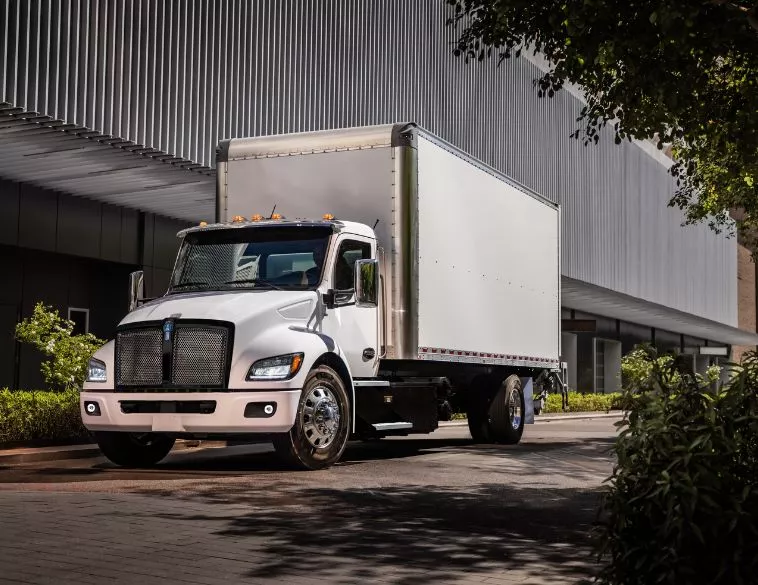
Kenworth today announced the launch of its first conventional medium-duty battery-electric trucks: the T280E, T380E, and T480E. These new Class 6-8 BEV models extend Kenworth’s commitment to providing fleets with versatile, zero-emission solutions designed for a wide variety of applications, including pickup and delivery, utility, regional haul, and vocational applications. Kenworth’s latest BEV offerings are now available for order from Kenworth dealers in the U.S. and Canada, with production scheduled to begin in 2026.
“The launch of our new medium-duty battery-electric lineup demonstrates Kenworth’s dedication to helping customers transition to zero-emission transportation with practical, powerful, and flexible solutions,” said Kevin Haygood, Kenworth’s assistant general manager for sales and marketing. “The T280E, T380E, and T480E are engineered to deliver the performance and dependability our customers expect from Kenworth, while offering the benefits of reduced emissions and quiet operation.”
Kenworth’s all-new medium-duty BEVs are powered by PACCAR’s fully integrated ePowertrain platform, offering multiple eMotor ratings from 170kW (230 hp continuous, 335 hp peak) up to 350kW (470 hp continuous, 605 hp peak), with peak torque ratings of 1,100 or 1,850 lb.-ft. This flexible platform allows customers to spec trucks for local delivery routes, regional distribution, or vocational applications that require higher power.
Battery configurations include two battery string options, which offer 250 kWh (up to 200 miles) and 375 kWh of energy storage (up to 280 miles), with the ability to charge in one hour, depending on battery string and charger type. All models feature DC fast charging capability with peak charging rates up to 350 kW, supported by PACCAR Parts’ full suite of charging solutions.
Medium-Duty Configurations
- Kenworth T280E (Class 6, 26K GVWR, U.S. non-CDL): The T280E is available with a two-string battery option, with eMotor ratings up to 270kW and 1,100 lb.-ft. of torque. The T280E offers up to 200 miles of range, making it ideal for pickup and delivery, as well as urban routes.
- Kenworth T380E (Class 7/8, 33-50K GCWR): The T380E is available as a truck or tractor with two or three-string battery options and eMotor ratings up to 350kW and 1,850 lb.-ft. of torque. With up to 280 miles of range, the T380E is suited for pickup and delivery, regional haul, utility, and light vocational applications.
- Kenworth T480E (Class 8, 66-82K GCWR). The T480E is available as a truck or tractor with two or three-string battery options and eMotor ratings up to 350kW and 1,850 lb.-ft. of torque. The T480E offers up to 200 miles of range and is versatile for heavier pickup and delivery applications, drayage, utility, and select vocational applications.
According to Haygood, PACCAR’s central drive eMotor allows for wheelbase flexibility, lift axle installations, and vocational-friendly BEV integrations. Additionally, the T280E, T380E, and T480E feature factory-installed options for high-voltage ePTO ports, which can be utilized to power equipment, a mechanical ePTO, or body configurations in conjunction with aftermarket body upfitters.
Kenworth’s medium-duty BEVs leverage the features of its combustion counterparts. Inside the cab, the latest in driver-focused technology includes the Kenworth SmartWheel and a 15” Digital Display. Dash and vocational features like RAM Mounts and factory-installed PTO switches are available. Throughout the exterior and interior of Kenworth’s new medium-duty BEVs, blue hydrographics and Kenworth bugs are featured to symbolize the advanced zero-emission technology.
“Kenworth builds a truck and a powertrain for every job and is proud to expand our comprehensive range of battery-electric models across both vocational and on-highway markets,” said Haygood. “With the addition of the T280E, T380E, and T480E, customers now have even more options to spec trucks that align with their business needs and sustainability goals.”